NPR’s Morning Edition interview and excerpts galore!

NPR’s Morning Edition ran an interview with me about the book this morning. Click here to listen to the whole 5-minute segment, read a summary, and an excerpt of the book’s introduction.

But wait, that’s not all!

Slate has published the first of two adaptations from the book:
Consent of the Networked: How can digital technology be structured and governed to maximize the good and minimize the evil?

Over the weekend Canada’s National Post published two excerpts from the China chapter:

Inside China’s Censorship Machine

and

China’s “Networked Authoritarianism”

Enjoy!

The 2012 Elections and the Surveillance State

This week CNN.com ran an opinion piece to which they assigned the headline, We’re losing control of our digital privacy. The essay actually focuses on a very specific invasion of privacy: government surveillance of American citizens through privately-run digital platforms and services. This is a problem I discuss at length in Chapter 5, “Eroding Accountability.”

In the article I point out:

Under two successive administrations, new laws, policies and corporate practices have made it much easier for government agencies to track and access citizens’ private digital communications from their storage “in the cloud” than it is for agents to search or monitor our physical homes, offices, vehicles, and mail.

After citing a number of concrete examples I then raise a question:

In the Internet age, it is inevitable that corporations and government agencies will have access to detailed information about people’s lives. We willingly share personal information with companies for the convenience of using their products. We accept that a certain amount of surveillance is necessary in order to protect innocent people from crime and terror. But as a nation we have failed to address the resulting dilemma: How do we prevent the abuse of the power we have willingly delegated to government and companies?

The essay concludes:

In 2012, the American people rightly expect presidential and congressional candidates to explain how they plan to protect us from crime and terror. In the Internet age, that inevitably requires some degree of surveillance. Yet it is equally vital we demand a clear vision of how they will protect us from abuses of government surveillance power through the corporate-run digital platforms upon which we are increasingly dependent.

Click here to read the whole thing

Why doesn’t Washington understand the Internet?

Part Three of the book is titled “Democracy’s Challenges.” At the end of Chapter 7, dealing with copyright enforcement and free speech, I conclude:

It is a moral imperative for democracies to find new and innovative ways to protect copyright in the Internet age without stifling the ability of citizens around the world to exercise their right to freedom of speech, access information they need to make intelligent voting decisions, and use the Internet and mobile technologies to organize for political change. Balanced, citizen-centric solutions will require innovation, creativity, and compromise. Sadly, the elected leaders of the world’s oldest democracies are disappointing the people who could most use their help by demonstrating very little enlightened leadership and a great deal of short-term self-interest.

This weekend, the Washington Post is running a piece by me about the clash between Washington culture and Internet culture in the wake of last week’s battle in Washington over copyright law. It begins:

In late 2010, on the eve of the Arab Spring uprisings, a Tunisian blogger asked Egyptian activist Alaa Abdel Fattah what democratic nations should do to help cyber­activists in the Middle East. Abdel Fattah, who had spent time in jail under Hosni Mubarak’s regime, argued that if Western democracies wanted to support the region’s Internet activists, they should put their own houses in order. He called on the world’s democracies to “fight the troubling trends emerging in your own backyards” that “give our own regimes great excuses for their own actions.”

The ominous developments that Abdel Fattah warned about are on display in Washington today in the battle over two anti-piracy bills. This fight is just the latest example of how difficult it is for even an established democracy to protect both intellectual property and intellectual freedom on the Internet — all while keeping people safe, too. It is a challenge that Congress has historically failed to meet.

I conclude:

The computer coding pros — and the millions who depend on their products — have said “no” to legal code they hate. But killing a bad bill is only the first step. The next and more vital step is political innovation. Without a major upgrade, this political system will keep on producing legal code that is Internet-incompatible.

Click here to read the whole thing.

Netizen Report: Fight for the Future Edition

By monashosh on Flickr

Meet Khaled Alaa Abdel Fattah, born last Tuesday to two Egyptian cyber-activists: mother Manal Bahey al-Din Hassan and father Alaa Abd El-Fattah, who is currently in prison. Khaled is named after Khaled Said, the young man whose violent death at the hands of police in 2010 became a symbol and rallying point for activism that brought down the Mubarak regime earlier this year.”

Little Khaled was born as Internet-driven activism in another part of the world, Russia, is bringing a new generation of young people – many of whom had never participated in a protest beforeinto the streets to oppose election results that they believe to have been rigged in the ruling party’s favor. One blogger told TIME magazine that he risked reprisals by United Russia supporters to post flyers around Moscow on the eve of the election, calling on people to vote against them. One flyer said:

“One day, your child will ask you, Papa, what were you doing when the crooks and thieves were robbing our country blind?”

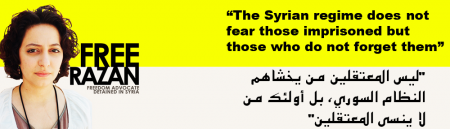
People like Alaa, Syrian blogger Razan Ghazzawi who was arrested on the Jordanian border last weekend, and Ali Abdulemam, the Bahraini blogger who has been in hiding since February, are all fighting for a world in which their own children will be able to speak their minds and participate in opposition politics without going to prison. But what about the rest of us? To echo the Russian blogger’s question:

What are we doing to make sure that our children will even be able to use the Internet to fight for their rights speak truth to power?

The war for freedom and control of the Internet continues to rage. To get the full rundown, check out the latest Netizen Report on Global Voices Advocacy. Since September I have been working with the Global Voices team and several volunteers to publish these twice monthly updates on global developments related to the power dynamics between citizens, companies and governments on the Internet. You can even subscribe to them by e-mail here.

An open thank you letter to Global Voices, on International Volunteer Day

Consent of the Networked was inspired in large part by the amazing community of people who contribute to the citizen media platform Global Voices. GV grew out of a gathering of international bloggers that my friend and former colleague Ethan Zuckerman and I organized at Harvard almost exactly seven years ago. In the preface, I describe how the book’s argument is informed in no small part by my experiences in working with the Global Voices community. A number of the stories I tell, and examples I cite to back up arguments throughout the book, were first told or exposed by GV contributors. In chapters 2 and 14 I describe Global Voices as part of an emergent networked civil society – which I call the “digital commons” – whose development and growth is critical to ensure that the Internet evolves in a manner that is compatible with democracy and human rights; not just the interests of the world’s most powerful governments and corporations. A few postings and articles I’ve written about Global Voices over the years include:

Today Ethan and I wrote the following open letter of thanks to the GV community:

—-

Today is International Volunteer Day, a celebration of the millions of people around the world who give their time, energy and wisdom to projects and causes they care about. Volunteers feed the hungry, care for the sick, comfort the grieving. We live in a world where companies and governments are responsible for producing most of the products and services we need and use. Volunteers prove that there’s another way to build things – we can write encyclopedias or operating systems, we can report the news, or host a revolution.

Choosing to build a volunteer community was the key decision that made Global Voices possible. Rebecca and I realized that some of the most interesting information we were getting from the developing world wasn’t coming from professional reporters, but from volunteers, using their blogs to share their perspectives on local and national events with the wider world. Our first action as a community – the manifesto that continues to inform and govern our decisions today – was co-written by volunteers at our first meeting, and rapidly translated into twenty five languages by volunteers.

While there’s a small team of editors and coordinators for whom Global Voices is a job (as well as a passion – we don’t pay well enough for anyone to do this for the money!), the lifeblood of our project is our volunteer community. 532 active volunteers are responsible for Global Voices today, part of the 1,904 volunteers who’ve worked on writing, editing, translating, designing over the seven year life of our endeavour. Volunteers have written more than 58,000 articles on Global Voices, and translated even more. We rely on an even broader community of volunteers – the tens of thousands of bloggers, twitterers and videographers who we feature on our site, the vast majority of whom create not for fiscal gain, but out of passion and dedication – to make our work possible. And we’re governed by volunteers: our board of directors serve without pay, giving their time because they care about our work and the sustainability of our community.

As co-founders of Global Voices, Rebecca and I are profoundly grateful to everyone who gives their time and energy to make the world more just, fair, knowledgeable and connected. But we wanted to call attention to two volunteers who’ve taken incredible risks to work with us. Late last week, Razan Ghazzawi was arrested by Syrian authorities when she travelled to Amman, Jordan to attend a workshop on press freedom. Razan is an active blogger and twitter user, and has written for Global Voices and Global Voices Advocacy. She’s one of several brave Syrians who is willing to work under her own name, despite the dangers of arrest, and we hope for her speedy release from detention.

We also recognize Ali Abdulemam, a Bahraini blogger, activist and Global Voices volunteer. Ali remains in hiding today, because he’s been sentenced to fifteen years in prison by Bahrain’s courts, who accused him of plotting a coup. In fact, Ali was sentenced because he’s been a passionate advocate for online speech in Bahrain, and has been arrested and tortured for his work on Bahrain Online and Global Voices. We are profoundly grateful for everyone who volunteers their time and energy to make Global Voices a reality. We pledge to work with you to make possible a world where no one ever need risk arrest to participate in a remarkable community like ours.

Ethan Zuckerman and Rebecca MacKinnon, Global Voices co-founders and volunteers

Stop the Great Firewall of America

Last month the U.S. Trade Representative Ron Kirk sent a letter to the Chinese government requesting information about its censorship practices. The middle kingdom’s response: a polite middle finger. Foreign ministry spokeswoman Jiang Yu declared that Chinese censorship follows “international practice.”

Her response is specious given that China operates the world’s most elaborate and opaque system of Internet censorship, as I describe in Chapter 3. Yet Congress has been hard at work to bolster its legitimacy, however inadvertently. The reality is that the PROTECT IP Act now in the Senate, and a new House version called Stop Online Piracy Act (SOPA), would bring key features of China’s Great Firewall to America. Read my opinion piece in the New York Times for more details on how these bills would implement technical and legal solutions that would have the unfortunate result of making the Internet everywhere more like the Chinese Internet.

The House Judiciary Committee will hold a hearing on SOPA at 10am on Wednesday morning (a few hours from now). It will be webcast live on the committee website. The video should also be archived there after the event.

Opposition to SOPA is widespread, bipartisan, and international. The Center for Democracy and Technology is collecting links to blog posts, articles, as well as letters of opposition from human rights groups, Internet engineers, law professors, Internet companies, public interest advocates, consumer rights groups, among others. Allan Friedman at the Brookings Institution has an excellent paper explaining how SOPA and PROTECT IP will make the Internet less secure, sabotaging engineers’ long-running efforts to increase the level of security in the global domain name system.

The New America Foundation (where I am a senior fellow) has signed an open letter to the House Judiciary Committee, along with a list of human rights, civil liberties and public interest groups. It argues:

We do not dispute that there are hubs of online infringement. But the definitions of the sites that would be subject to SOPA’s remedies are so broad that they would encompass far more than those bad actors profiting from infringement. By including all sites that may – even inadvertently – “facilitate” infringement, the bill raises serious concerns about overbreadth. Under section 102 of the bill, a nondomestic startup video-sharing site with thousands of innocent users sharing their own noninfringing videos, but a small minority who use the site to criminally infringe, could find its domain blocked by U.S. DNS operators. Countless non-infringing videos from the likes of aspiring artists, proud parents, citizen journalists, and human rights activists would be unduly swept up by such an action. Furthermore, overreach resulting from bill is more likely to impact the operators of smaller websites and services that do not have the legal capacity to fight false claims of infringement.

In Chapter 7 I describe my experience testifying at a March 2010 House Foreign Relations Committee hearing chaired by Rep. Howard Berman (D-CA). Berman happens to be one of SOPA’s key sponsors. While the hearing’s stated purpose was to discuss Google’s decision to halt censorship in China and how the United States can support global Internet freedom, committee members devoted considerable time to chastising a Google executive for failing to sufficiently police uploads to YouTube for infringing content. By their standards, YouTube and other similar user-driven sites clearly fall short of SOPA’s requirements. As I point out in the book, The cognitive dissonance on display at that hearing highlighted an inconvenient reality: politicians throughout the democratic world are pushing for stronger censorship and surveillance by Internet companies to stop the theft of intellectual property. They are doing so in response to aggressive lobbying by powerful corporate constituents without adequate consideration of the consequences for civil liberties, and for democracy more broadly.

The public interest letter details some of those consequences:

Relying on an even broader definition of “site dedicated to theft of US property,” section 103 of SOPA creates a private right of action of breathtaking scope. Any rightsholder could cut off the financial lifeblood of services such as search engines, user-generated content platforms, social media, and cloud-based storage unless those services actively monitor and police user activity to the rightsholder’s satisfaction.

In my op-ed I conclude:

The potential for abuse of power through digital networks — upon which we as citizens now depend for nearly everything, including our politics — is one of the most insidious threats to democracy in the Internet age. We live in a time of tremendous political polarization. Public trust in both government and corporations is low, and deservedly so. This is no time for politicians and industry lobbyists in Washington to be devising new Internet censorship mechanisms, adding new opportunities for abuse of corporate and government power over online speech. While American intellectual property deserves protection, that protection must be won and defended in a manner that does not stifle innovation, erode due process under the law, and weaken the protection of political and civil rights on the Internet.

I am not against copyright or intellectual property protection – I’m about to publish a copyrighted book. I hope that people will buy it. Its quality owes a great deal to the editors and other professionals whose job it was to help me shape and refine my argument, and to improve my prose. But I don’t believe that the defense of my copyright should come at the expense of civil liberties. It is a moral imperative for democracies to find new and innovative ways to protect copyright in the Internet age without stifling the ability of citizens around the world to exercise their right to freedom of speech and assembly on the Internet.

Surveillance and Censorship in India

Chapter 9 opens with quotes from an infamous April 2011 BBC interview with RIM’s co-CEO Mike Lazaridis, in which he ends the interview abruptly after the BBC’s Rory Cellan-Jones presses him to answer questions about RIM’s “arguments with the Indian government and various other governments in the Middle East” over those governments’ desire to gain access to Blackberry messages and e-mails.  In August 2010, the United Arab Emirates and Saudi Arabia  threatened to ban BlackBerry services until RIM agreed to allow a satisfactory level of government access to communications sent through RIM devices within the country. India soon followed suit with its own demands for access. Late last month, the Wall Street Journal reported that RIM has set up a facility in Mumbai “to help the Indian government carry out lawful surveillance of its BlackBerry services.” The report further quotes a RIM statement which says that “we believe the government of India is now applying its security policy in a consistent manner to all handset makers and service providers in India, which means that RIM should not be singled out any more than any other provider.”

There is a larger problem, however. When it comes to censorship in India, the hardworking folks at the Centre for Internet and Society in Bangalore recently concluded that the Indian government is violating not only Indian laws but also the Indian Constitution in the way it handles censorship demands to companies. What are the chances, then, that the Indian government is not violating its citizens’ rights in similar ways when it comes to demands for user information to RIM and other mobile service providers?

CIS’s Pranesh Prakash compared Google’s most recent Transparency Report, which reveals the number of content removal and user data requests made between January and June 2011 by the Indian government, and compared that information with an official response to CIS queries on content removal and blocking by the Ministry of Communications & Information Department of Information Technology. Prakash’s conclusion:

…it would seem that law enforcement agencies are operating outside the bounds set up under the Indian Penal Code, the Code of Criminal Procedure, as also the Information Technology Act, when they send requests for removal of content to companies like Google. While a company might comply with it because it appears to them to violate their own terms of service (which generally include a wide clause about content being in accordance with all local laws), community guidelines, etc., it would appear that it is not required under the law to do so if the order itself is not legal.

However, anecdotal evidence has it that most companies comply with such ‘requests’ even when they are not under any legal obligation to do so.

This way the intention of Parliament in enacting s.69A of the IT Act—to regulate government censorship of the Internet and bring it within the bounds laid down in the Constitution—is defeated.

As I reported in the book, in April 2011, the Ministry of Communications and Information Technology issued new rules under which Internet companies are expected to remove within thirty-six hours any content regulators designated as “grossly harmful,” “harassing,” or “ethnically objectionable.” Indian free speech advocates have vowed to challenge the rules’ constitutionality. Google publicly protested the rules in a statement warning that “if Internet platforms are held liable for third party content, it would lead to self-censorship and reduce the free flow of information.” As Prakash put it then, “The Indian Constitution limits how much the government can regulate citizens’ fundamental right to freedom of speech and expression. Any measure afoul of the constitution is invalid.”

More details about surveillance and censorship in India can be found in the India-focused chapter of a new book, Access Contested: Security, Identity, and Resistance in Asian Cyberspace, produced by the Open Net Initiative, coming out in December from MIT Press. The India chapter is not currently available online but I discuss India’s issues in a related chapter titled “Corporate Accountability in Networked Asia” (The Citizenlab, one of ONI’s partners, has made that chapter, along with all of Part I of the book, available online here.) I wrote it late last year and it went into production before the new April 2011 rules came out (academic presses take a long time), but I think the larger point remains very relevant. I compare the role played by companies in facilitating government censorship and surveillance in China to the role of companies in two Asian democracies: South Korea and India. I argue that “efforts to hold companies accountable for free speech and privacy in authoritarian countries like China will face an uphill battle unless companies in Asia’s democracies are pushed by domestic civil society actors to defend and protect user rights in a more robust manner than is currently the case.”

The first step is for companies to follow Google’s lead in being more transparent about how they respond to government demands. Then civil society organizations in democracies, like India’s CIS, will be equipped and empowered with the information they need to push their governments to stop using companies as an opaque and unaccountable extension of state power. RIM can and must recognize that by being evasive with the public it is standing firmly on the wrong side of history.

Here is the video of Lazaridis’ interview:

Surveillance technologies and “apolitical” corporations

Since the book’s manuscript was finalized in August, there has been a steady stream of headlines recently about the use of Western surveillance technology by repressive regimes, adding to the cases I described in Chapter 4 and elsewhere. One of the biggest stories has been the revelation by the hacktivist group Telecomix that the Syrian government continues to use censorship and monitoring devices manufactured by the California-based company Blue Coat. Late last month the company has finally acknowledged that at least thirteen of its devices are being used by Syria.

Today, The Guardian has an amazing article titled “Governments turn to hacking techniques for surveillance of citizens.” It describes the annual Intelligence Support Systems (ISS) World Americas  conference, at which surveillance firms share tips on the latest “lawful interception” techniques used to spy on citizens. The companies showed little concern for how this technology can be and is being abused around the world. An excerpt:

Jerry Lucas, the president of the company behind ISS World, TeleStrategies, does not deny surveillance developers that attend his conference supply to repressive regimes. In fact, he is adamant that the manufacturers of surveillance technology, such as Gamma International, SS8 and Hacking Team, should be allowed to sell to whoever they want.

“The surveillance that we display in our conferences, and discuss how to use, is available to any country in the world,” he said. “Do some countries use this technology to suppress political statements? Yes, I would say that’s probably fair to say. But who are the vendors to say that the technology is not being used for good as well as for what you would consider not so good?”

Would he be comfortable in the knowledge that regimes in Zimbabwe and North Korea were purchasing this technology from western companies? “That’s just not my job to determine who’s a bad country and who’s a good country. That’s not our business, we’re not politicians … we’re a for-profit company. Our business is bringing governments together who want to buy this technology.”

The Electronic Frontier Foundation has proposed a two-part “know your customer” framework for surveillance equipment:

  1. Companies selling surveillance technologies to governments need to affirmatively investigate and “know your customer” before and during a sale.  We suggest something for human rights similar to what most of these companies are already required to do under the Foreign Corrupt Practices Act and the export regulations for other purposes, and
  2. Companies need to refrain from participating in transactions where their “know your customer” investigations reveal either objective evidence or credible concerns that the technologies provided by the company will be used to facilitate human rights violations.

Click here for further details. One of the broader problems, of course, is that the market for ever-more sophisticated surveillance equipment feeds unaccountable abuses of power not only by authoritarian regimes but also by democratic governments.

As long as engineers and companies claim to have no responsibility for the political context in which their inventions and products are used, the problem is going to grow worse. This problem of “amoral” technology being used for immoral purposes has been exacerbated in the Internet age, but it has been around a lot longer. In a talk I gave last week at the Silicon Valley Human Rights Conference, I played a video clip from Tom Lehrer‘s early 1960’s song about ex-Nazi rocket scientist Wernher von Braun:

The lyrics :

Gather round while I sing you of Wernher von Braun,
A man whose allegiance
Is ruled by expedience.
Call him a Nazi, he won’t even frown.
“Ha, Nazi Schmazi,” says Wernher von Braun.

Don’t say that he’s hypocritical,
Say rather that he’s apolitical.

“Once the rockets are up, who cares where they come down?
That’s not my department,” says Wernher von Braun.

Some have harsh words for this man of renown,
But some think our attitude
Should be one of gratitude,
Like the widows and cripples in old London town
Who owe their large pensions to Wernher von Braun.

You too may be a big hero,
Once you’ve learned to count backwards to zero.
“In German oder English I know how to count down,
Und I’m learning Chinese,” says Wernher von Braun

Kudos and Concerns for Google

Earlier this week, Google published an update of its Transparency Report, which among other things discloses the number of government requests received for user information as well as requests to remove content. The latest report contains more granular data than ever before, including the number of actual users targeted by the government requests. (China remains a black hole because releasing the data would break China’s “state secrets” law and expose Chinese employees to prosecution.) As The Guardian points out, the data show a 70% increase in requests by the U.S. government or police. The company has also refused some takedown requests, including video of police brutality.  In the first half of 2011, Brazil topped the list with the most requests for content removal, followed by Germany, the U.S., and South Korea.

In the book I argue that inadequate transparency and accountability at the nexus between state and corporate power is one of the most insidious threats to democracy in the Internet age. All Internet and telecommunications companies should be required to report regularly and systematically to the public on how content is policed, and under what circumstances it gets removed or blocked and at whose behest. All companies serious about building public credibility and trust should waste no time in following Google’s lead.

Google still has a long way to go, however, when it comes to managing the development and rollout of its various services in a way that does not hurt its most vulnerable users. As Chapter 10 described, the implementation and enforcement of the real-name identity policy on Google Plus has thus far been a fiasco, resulting in dissidents and other vulnerable users around the world being booted from the service. Google’s Senior VP of Social Vic Gundotra recently announced that the social network will “soon” provide support for pseudonyms and other forms of alternative identity not tied to people’s government-issued ID. However it remains unclear what “soon” means.

Meanwhile, Google has announced that it will soon make major changes to Google Reader (an RSS reader used by many people to follow, manage, and share content from a large volume of news and blog feeds). Some of the social sharing functions will be eliminated and Reader will be integrated more closely into Google Plus. What Google staff apparently did not anticipate is how these changes will hurt some users including Iranian users struggling to share information despite harsh censorship. Because Google Reader is encrypted with https, it is harder for the Iranian government to block than most other overseas sites and services. As one Iranian blogger explains:

Google Reader acts like a news spreading website. Easy access to Google reader made it suitable for Iranian community and through all these years, specially after June 2009 election, developed an strong community for spreading the news.

Elimination of Reader’s sharing functions will put an end to this. Even worse, if Reader is integrated with Google Plus before the company finds a way to accommodate pseudonymous users and other forms identity not tied to people’s government-issued identity, Iranian users will be left even further in the cold.

Tunisia and the Internet: A chance to get things right?

This coming Sunday (October 23rd, 2011), Tunisia will hold elections for the constituent assembly that will be tasked with re-writing the country’s constitution. While this election is only the first step in a long and winding path that may or may not succeed in establishing a vibrant Arab democracy in North Africa, reports are quoting election observers and human rights groups who are optimistic that people are serious about the process of holding a real election.

Censorship is a major topic in the Tunisian political discoure. There have recently been protests by conservatives demanding censorship of all media including TV, film, and Internet and protests by liberals against censorship. After  Internet censorship was ended when President Zine El Abidine Ben Ali fled the country in January, some censorship of pornographic and incendiary web content resumed in May of this year, prompting heated debates over who has the authority to decide what goes on the censorship list and whether that power will inevitably be abused.

At the Third Arab Bloggers Meeting in Tunis earlier this month, Moez Chakchouk, Chairman and CEO of the Tunisian Internet Agency, gave an amazing presentation (slideshow included) in which he revealed that under Ben Ali, his agency had secretly tested censorship and surveillance software for Western companies. He would not say which ones, although according to Jillian York of the Electronic Frontier Foundation, Tunisia long used McAfee’s SmartFilter to censor the Internet under the Ben Ali regime, and controversially has resumed some filtering  in a much more limited way during the transition.

ATI (as the Tunisian Internet Agency is known according to its French acronym) was much reviled by activists under Ben Ali and nicknamed “Ammar 404” – the Arabic equivalent of “Joe 404,” with “404” referring to the “404 page not found” error message that appears on browsers when a web page has been blocked. Now Mr. Chakchouk says he is trying to turn the agency into a “transparent” and “neutral” Internet exchange point (IXP) that can support a robust public discourse in an evolving new democracy. He wants to put an end to web filtering at the network level and instead provide tools and services for households to filter their home Internet if they so desire, without engaging in blanket censorship for the entire nation. In general, he believes that Tunisia must foster competition and innovation in Internet services. He wants Tunisia adopt global “best practices” in Internet governance.

After a Tunisian court ruled in May that some websites must be blocked, the ATI appealed the ruling twice, but lost both appeals. It is making a further appeal to the highest court.

Click here for a video of Chakchouk’s entire speech in French (perhaps somebody will give it English and Arabic subtitles at some point). Here is a shorter English interview he did immediately afterwards with Tunisia Online:

Whether Mr. Chakchouk will succeed or even keep his job, or whether the ATI will survive as an independent agency, Tunisian activists told me at the conference, will depend in no small part on the outcome of this weekend’s elections and the continued political jockeying beyond.

Riadh Guerfali, co-founder of the citizen media platform Nawaat.org which played a key role in spreading protest information and who is now running as an independent candidate from his home town of Bizerte (and who features prominently in chapters 1 and 14 of the book), has made Internet access and online free expression a key goal, as have many other former activists who are now running for office. On the other hand, there are other candidates – on both the left and the right – calling for Internet censorship as part of an effort to attract more conservative religious voters. Who will prevail in the election remains to be seen… and how the constituent assembly will choose to handle the questions of censorship and civil liberties when they write the constitution is even less clear.

“Information infrastructure is politics,” writes Philip N. Howard of Washington State University in a recently published Brookings Institution report on authoritarian regimes and Internet controls. Tunisian politics over the coming year are likely to determine the shape of the country’s information infrastructure – and decide just how different it will be from the past, or not. The shape of the infrastructure will in turn shape political discourse to the extent that it enables a full range of political viewpoints, debates, and even whistleblowing; or whether it enshrines censorship and surveillance mechanisms that can enable  power-holders to subtly (or not so subtly) manipulate information and surveil Internet users.